
Blogs & white papers
|
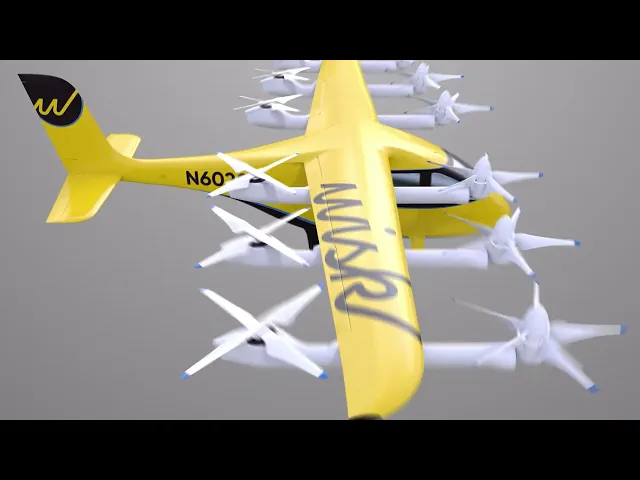
Delivering the world’s first all-electric, autonomous, four-passenger eVTOL (electric vertical takeoff and landing) air taxi requires more than just revolutionary design. It demands a continuous commitment to safety and rigorous testing.
A common question we receive is: How do you ensure an autonomous aircraft is safe before it ever takes off? The answer lies within our multi-layered validation ecosystem. Long before our autonomy stack ever integrates with our Gen 6 aircraft, it goes through tons of testing and evaluations. By leveraging advanced aviation software, end-to-end flight simulation, and real-world testing on surrogate aircraft like helicopters, Wisk is setting a new global standard for autonomous aviation safety.
Here is a behind-the-scenes look at how we test, refine, and prove our autonomy technology every single day.
Bridging the Digital and Physical: The Software and Hardware-in-the-Loop Pipeline
The journey of our autonomy stack begins in the digital world, but it doesn't stay there for long. As Ben Harvey, Senior Manager of Advanced R&D at Wisk, explains, our rigorous testing methodology relies on a strict, progressive pipeline designed to systematically eliminate risk.
We start with software simulation, virtually modeling the complex environments our aircraft will navigate. Once the software proves its baseline capabilities, we graduate to Hardware-in-the-Loop (HIL) simulation. In this phase, we connect our physical flight computers and tactical sensors to our simulation environment on a benchtop rig. This ensures our software behaves perfectly when interacting with real physical components.
Once a technology is proven on the benchtop, we migrate the entire system into a surrogate helicopter. Using a helicopter as a real-world testbed allows us to fly our autonomy suite in live airspace. This step is crucial, as it exposes our sensors and software to real-world atmospheric conditions, unexpected wind shears, and actual airspace dynamics. Once our autonomy suite, consisting of software, sensors, and computers, is ready for our Gen 6 aircraft, it will have already been thoroughly tested in the sky.
One Flight, Endless Possibilities: The Power of Cloud-Scale Simulation
Our advanced simulation models and cloud infrastructure change the game for real-world flight testing.
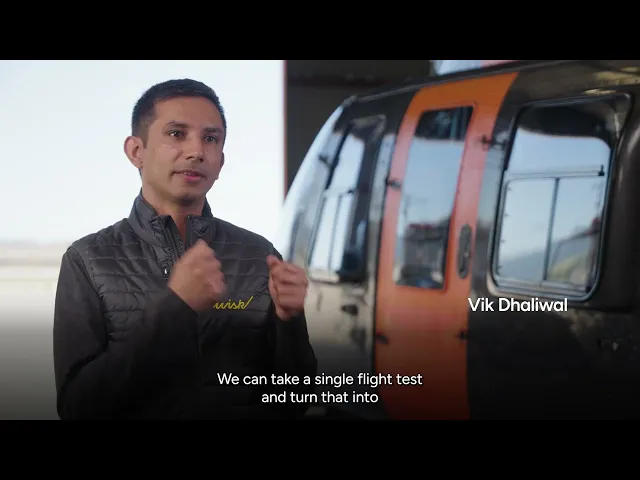
Vik Dhaliwal, Wisk’s Manager of Conflict Detection & Resolution (Autoflight & Navigation), explains how Wisk captures data from a single physical flight test and turns it into thousands of simulated flights. By feeding real-world ground truth into our cloud infrastructure, we can vary environmental factors such as weather, visibility, traffic density, and flight paths.
This massive scalability is vital for validating our Detect and Avoid (DAA) algorithms. Our DAA system is what allows the aircraft to autonomously remain clear of other air traffic. Our cloud-based parallel testing allows us to simulate high-risk traffic scenarios at a scale and frequency impossible to replicate in the real world. By continuously stress-testing our algorithms in a digital environment first, we ensure that every minor update is hyper-optimized before deployment, maximizing the safety, precision, and purpose of our physical surrogate flights.
Seeing the Unseen: Pioneering Next-Generation Radar for Airspace Awareness
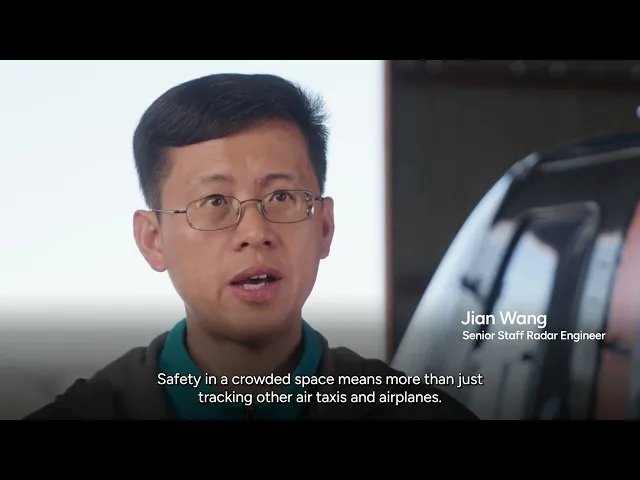
Maintaining total situational awareness in crowded urban airspaces means tracking more than just cooperative commercial airplanes. It means identifying uncooperative aircraft, gliders, and unexpected obstacles.
As Jian Wang, Senior Staff Radar Engineer, points out, while the rest of the aviation industry waits for standard solutions to emerge, Wisk has proactively initiated the certified testing of advanced airspace radar systems. Our target is clear: solving the incredibly difficult problem of detecting unseen air traffic with unprecedented precision.
Through intensive flight testing, data analysis, and close collaboration with industry experts from Boeing and other partners, we are validating next-generation radar systems directly on our surrogate aircraft. This certified radar technology acts as a core pillar of our Detect and Avoid (DAA) strategy. We aren't simply meeting the current regulatory bar; we are actively establishing a brand-new gold standard for autonomous flight safety.
Building Trust in Autonomous Flight
Every simulation run, every hardware test, and every hour logged by our surrogate helicopters serves a singular purpose: building an airtight case for safety. We understand that introducing autonomous Advanced Air Mobility (AAM) to the world requires more than just innovative engineering. It requires earning the public's confidence in safety. The processes we go through to thoroughly prove our autonomy stack via software, simulation, and surrogates are just one way to earn that trust, well before Wisk’s Gen 6 aircraft takes to the skies with passengers onboard.